GST and tax reminder posts for accountants: a year of useful client reminders
GST due date posts for clients that people actually act on: the reminder ladder, wording templates, client groups and a year-round plan for accountants and tax consultants.
Two days before the return is due, your phone starts. A shop owner has not sent his sales register. A trader wants to know if the date has been extended "like last time." A client's daughter sends a photo of a crumpled purchase bill at 11 at night. You did send a reminder, a week ago, as a forwarded text in a broadcast list. Nobody read it.
Most accountants and tax consultants already know their clients need reminding. The problem is that most reminders do not work. They arrive too late, say too little, or look like every other forward on a client's phone. Good GST due date posts for clients are different: they arrive early, they tell the client exactly what to send, and they look like they came from a firm the client trusts. This guide is about making reminders that people act on, and building a year of them without writing each one at midnight.
A quick note before we start: this post does not list due dates, on purpose. Dates are set by the authorities, they differ by return type and client category, and they are sometimes extended. Always check the current due date on the official portal or notification before any reminder goes out.
Why most tax reminders get ignored
Think about how a client sees your reminder. It lands between family videos, a supplier's price list and three good-morning images. If it is a long text with return names they do not understand, they skip it. If it arrives the day before the date, it causes panic rather than action.
Reminders get ignored for four common reasons:
- Too late. One message close to the due date leaves no time to collect documents.
- Too technical. Return form names mean a lot to you and very little to a sweet shop owner.
- No clear action. "Due date approaching" does not say what the client has to do today.
- No identity. A plain forward could be from anyone. A clean, branded post from your firm is recognised and trusted.
Fix those four and your tax reminder posts start doing real work for your practice.
The reminder ladder: four posts for every deadline
Instead of one reminder per deadline, use a short ladder of posts. Each one has a different job.
| Step | When | What it says | The client's action |
|---|---|---|---|
| 1. Heads-up | Well before the date | "Your monthly or quarterly filing is coming up. Check the current due date." | Start gathering papers |
| 2. Document checklist | A little later | "Please send: sales invoices, purchase bills, credit notes, bank statement." | Send documents |
| 3. Last call | A few days before | "If you have not sent your papers, please do so today so we can file on time." | Respond now |
| 4. Done and next | After the date | "Filing season done. Keep this month's bills in one folder for the next one." | Build a habit |
The ladder works because the client hears from you before the rush, gets a clear checklist, and is never surprised. It also spreads your own work across the month instead of piling it into the last two days.
GST due date posts for clients: wording that works
Keep the language plain, short and calm. Here are reminder lines you can adapt. Each one avoids stating a date as fact and points the client to check.
Heads-up post:
Your GST return for this period is coming up. Please check the current due date and start keeping your sales and purchase bills ready. Every business is different: speak to your accountant about your own filings.
Checklist post:
Filing season checklist: sales invoices, purchase bills, debit and credit notes, expense bills, bank statement. Send them together in one message or one folder to save time.
Last call post:
Have you sent your documents for this period's filing? Please share them today so your return is not rushed. Check the current due date on the official portal.
Extension post:
You may hear that a due date has been extended. Please confirm from the official notification or ask us before you relax. Rumours on WhatsApp are not always correct.
Habit post:
One folder, one month. Keeping every bill in one place makes the next filing faster and reduces mistakes.
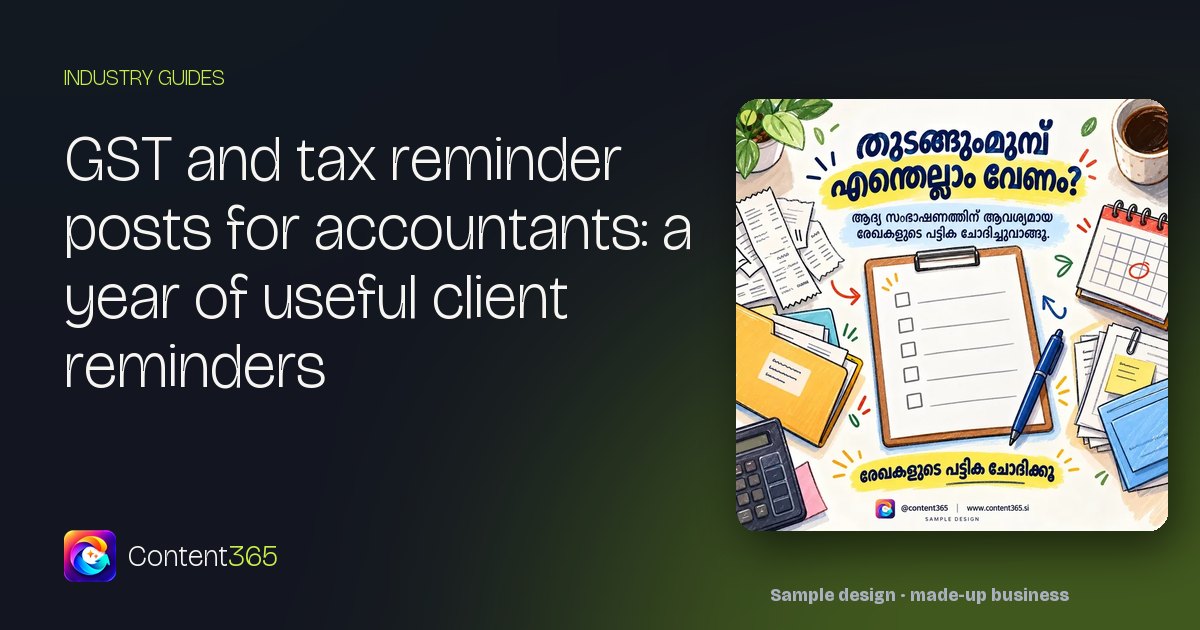
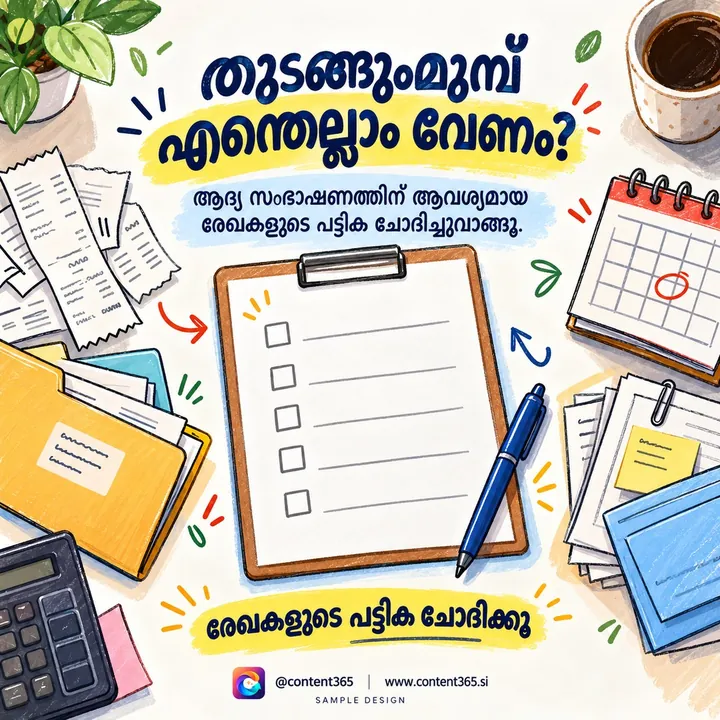
The picture should carry only a short headline, your firm's logo and contact. The detail goes in the caption, where you can be careful and complete.
Group your clients, then group your posts
Not every client needs every reminder. Social media posts reach everyone, so keep public posts general, and use the client group to decide the timing and topic of each month's posts.
| Client group | What they need reminders about | Post idea |
|---|---|---|
| Monthly GST filers | Monthly returns and document flow | Monthly heads-up and checklist |
| Quarterly filers | Quarterly returns and any monthly payments that apply | "Quarterly filers: check what applies to you this month" |
| Small and composition businesses | Their own periodic returns and simple record-keeping | Bill-keeping habits, a plain-words explainer |
| TDS deductors | Quarterly TDS returns and deposits | "Deducted TDS? Check the deposit and return dates" |
| Individuals and salaried clients | Income tax return season after the financial year closes on 31 March | ITR filing reminder post and document checklist |
| Businesses and professionals paying advance tax | Advance tax instalments during the year | "Advance tax may apply to you: check the current due dates with your CA" |
An ITR filing reminder post works best as a short series: a "documents to keep ready" post (Form 16 for salaried people, bank interest certificates, investment proofs, rent receipts where relevant), a "check your details" post, and a last-call post. Keep each one general and tell readers to check the current due date and speak to their accountant about their own case.
A year of reminders, month by month
Here is a planning frame for a year of accountant social media ideas built around reminders. It does not give dates. Before each month starts, check the current due dates for that month and set your ladder.
| Period | Reminder themes | Supporting posts |
|---|---|---|
| April | New financial year begins, usually on 1 April | New invoice series, fresh books, "start the year organised" |
| The months after 31 March | ITR season for many individuals, TDS returns for the last quarter | Documents checklist, Form 16 explainer, "do not wait for the last week" |
| Every month | GST monthly filings and payments | The four-step ladder |
| Every quarter | Quarterly GST and TDS cycles | Quarterly heads-up, "which returns apply to you" |
| At intervals through the year | Advance tax instalments | "Check whether advance tax applies to you" |
| Audit season | Audit and related filings for businesses that need them | Documents for audit, meeting your CA early |
| October to November | Festive season, Diwali in October or November | Festive greeting, year-end planning in general terms |
| January to March | Financial year end on 31 March | Year-end checklist, investment proofs, "close your books cleanly" |
For a fuller compliance-calendar plan, including weekly content beyond reminders, see our guide to CA firm social media content.

Where reminders work best
WhatsApp Status reaches every client who has your number, with no cost and no extra effort. A branded reminder on Status gets seen by clients who would never open a broadcast message. Our guide to WhatsApp Status marketing explains how to keep it useful rather than noisy.
LinkedIn is where business owners, CFOs and startup founders look for a firm that seems on top of things. Reminders there double as quiet proof of expertise. See LinkedIn posts for business owners for writing tips.
Instagram and Facebook reach younger business owners and salaried clients, especially in ITR season.
Many of your clients will prefer Hindi or a regional language for reminders. A Hindi line on a GST reminder often feels more natural to a trader than English. For tax consultant marketing, clarity in the client's language beats a clever headline every time.
Always follow your professional body's current guidance on advertising and solicitation, and keep reminders informative rather than promotional.
How Content365 gives your practice a year of posts
Content365 makes 365 branded posts for your firm, one for every day of the year, for ₹3,999 including GST. That is the whole year for one brand, not a monthly fee. A second practice or brand is the same ₹3,999 including GST. See pricing for details.
- One picture for every day. A 1080 x 1350 (4:5) image with a square-safe centre, ready for Instagram, Facebook, LinkedIn, X and WhatsApp.
- Your real logo and details. An image model paints a scene with no text in it. The studio's compositor then places your real logo, firm name, phone, website and call to action on top, from the exact text you gave. The logo is never redrawn by the model.
- Captions every day. For Instagram, Facebook, LinkedIn and X, plus Hindi.
- The financial year planned in. Indian festivals and the financial year are planned into the calendar on the days they fall.
- Variety. 365 angles across 5 lenses make 1,825 concepts in 21 angle families, mixed across the year. Near-duplicate pictures are rejected.
- Checked pictures. A vision model checks every picture for stray text and problems, with up to 3 tries per day. A day that never passes still arrives, with a visible warning.
Use these posts as the steady base of your page and add your own GST due date posts for clients on top, as a reminder ladder, with dates you have checked that month. You review every day in your own gallery first. We do not post on your pages: you or your staff do. Everything comes in one download folder with all pictures, captions.csv, prompts.csv, calendar.csv and a gallery that opens on any phone. Hosting lasts 90 days from payment, then ₹3,000 a year before GST, or keep the folder.
Try it free first: 2 posts for your brand every 48 hours, no payment needed. Start free with Google, or look at the yearly plan.
Frequently asked questions
How early should I post GST reminders for clients?
Start with a heads-up well before the date, then a document checklist, then a last call a few days before. Check the current due date for each return before you plan the posts.
Should my posts state the exact due dates?
Only after you have confirmed them from the official portal or notification for that period, and add "check the current due date" in the caption. Dates differ by return and client category and are sometimes extended.
What should an ITR filing reminder post include?
A short list of documents to keep ready, a reminder to check personal details, and a line to check the current due date and speak to an accountant about their own case. Keep it general.
Can tax reminder posts count as advice?
Keep them general: what to prepare and when to act, never what a specific client should claim or pay. End with "every case is different, speak to your accountant."
Does Content365 post the reminders on my firm's pages?
No. You review every day in your gallery, add your checked dates where needed, and post it yourself or through your team.
Make every deadline a calm one
Reminders that arrive early and say exactly what to send make your clients' month easier, and yours. Try the free posts, then get a year of posts for ₹3,999 including GST.