Financial year posts for CA firms: the March and April posts your page keeps missing
Financial year posts for CA firms: a simple plan for the 31 March close, the 1 April start and Diwali greetings, with lines that never stray into tax advice.
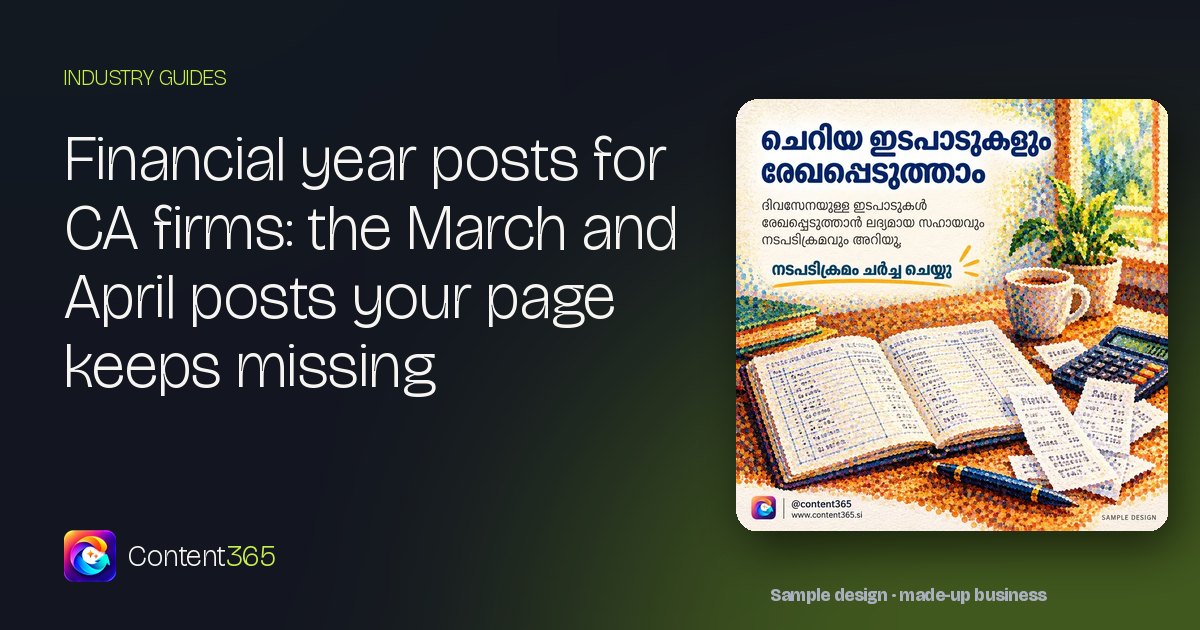
Every year your firm helps its clients close their books by 31 March. And every year, the firm's own page says nothing about it. The last fortnight of March disappears into files and phone calls, the first week of April goes in catching up, and by the time anyone opens the LinkedIn page it is the middle of April and the newest post is last Diwali's greeting.
Financial year posts for CA firms are the simplest posts a practice could make, and the ones most often missed. They need no tax content, no design skill and no clever idea. They only need to be ready before March begins. This guide shows which moments deserve a post, what those posts should say and leave out, and how to have them made in February so nobody has to think about them in March.
Why the financial year post is the one that slips
Three things work against it, and none of them is laziness.
The timing is the worst possible. The turn of the financial year is when the practice is at full stretch. A post competes with a client who needs something today, and the client wins every time, as they should.
Anything near tax feels risky in public. A partner hesitates to post at year end because any line about the season seems to invite a question about rules or deadlines. So the safest choice seems to be silence, at exactly the moment clients are thinking about their CA.
Nobody owns it. The partners assume an articled assistant will put something up. The articled assistant assumes a partner will want to approve it first. Both are busy, and the post never happens.
None of this says anything bad about the firm. The practice put its clients first, which is exactly what clients pay for. The fix is simply to take the decision out of March.
The financial year moments worth a post
You do not need a post every day of March to look present. You need a small set of posts on the days people notice. Here is a list of moments, with what each post should say and what it should leave out.
| Moment | When | What the post says | What it leaves out |
|---|---|---|---|
| The last fortnight | Mid to late March | Extended office hours, thanks for clients' patience | Deadlines, rates or instructions |
| The year closes | 31 March | Thanks for another year together | Figures, rules or advice |
| The new year begins | 1 April | A warm welcome to the new financial year | Predictions about tax changes |
| Back to normal | The first full week of April | Regular hours again, a note from the partners | Promises about refunds or outcomes |
| Diwali and new account books | October or November | A greeting to clients and their families | Sales talk of any kind |
| CA Day | 1 July | A short word about the profession and your team | Claims of being the best |
| Your firm's anniversary | Your own date | How long the firm has served the town | Client names or results |
The Diwali row matters more than it looks. Many trading families open new account books around Diwali, so for a firm with business clients, the festival is a second new year. Diwali moves every year and falls in October or November, so check the date before you plan for it.
For the rest of the year, our guide to CA firm social media content lays out a month-by-month plan and a weekly rhythm. This page stays on the handful of days around the financial year.

Greetings, not guidance: keeping these posts free of tax advice
A public post cannot know anything about the person reading it. One line about a rate, a limit or a rule can go out of date, or be applied by someone it was never meant for. That is why the safest financial year posts are greetings and gratitude, not guidance. Their job is to show clients that the office is open, the partners are on top of things, and someone is minding the page.
Your professional body also has rules on how members may advertise and seek work, and those apply on social media too. Read the current guidance, and when you are unsure, keep a post plainer than you think it needs to be. Whether the firm ever posts technical content is the partners' own professional call, and it is outside this guide.
Here are a few lines a firm could adapt. They are examples written for this guide, not taken from the product.
- 31 March: "Another financial year closes today. Thank you for trusting us with your books."
- 1 April: "A new financial year begins. Our office, and our phones, are open."
- First week of April: "Thank you for your patience through March. Our regular hours are back from Monday."
- Diwali: "Wishing you and your family a bright Diwali, and good beginnings for your new books."
- 1 April, in Hindi: "नए वित्त वर्ष की हार्दिक शुभकामनाएँ। आपके भरोसे के लिए धन्यवाद।"
Notice that none of them tells anyone what to file, pay, claim or change. That is the point.
Make the March posts in February
The way to stop missing these posts is to move all the work to a month when the office can breathe. February is usually that month.
- Pick one quiet afternoon in early February. Put it in the diary like a client meeting.
- Make every financial year post in one sitting, with the firm's logo and contact details on each, spelt the same way every time.
- Ask one partner to approve them all at once. One sign-off in February replaces seven anxious decisions in March.
- Name the person who posts. The office manager or a senior articled assistant gets the folder and a list of dates, and permission to post without asking again.
- Choose where each post goes. LinkedIn for companies and founders, WhatsApp Status and a client broadcast list for traders, and Facebook for families and smaller clients.
One picture can serve every platform with a caption suited to each. Our guide to captions for Instagram, Facebook, LinkedIn and X shows how to adjust the words, and LinkedIn posts for business owners covers how partners can post under their own names as well.
How Content365 puts the financial year on your calendar
The February afternoon above works. Content365 simply does that afternoon for the whole year at once.
You describe the firm one time: name, industry, logo and website. It then makes 365 branded posts, one for every day of the year. The financial year is built into that calendar, with the 31 March close and the 1 April start on their own days, and Indian festivals such as Diwali placed on the days they fall for that year.
Every post is a 1080 x 1350 picture with a square-safe centre, sized for Instagram, Facebook, LinkedIn, X and WhatsApp. Each day has a caption for every one of Instagram, Facebook, LinkedIn and X, and one in Hindi for clients who read Hindi first. An image model paints the scene with no text in it; the studio then adds the firm's real logo, name, number and website, exactly as you typed them. The logo is never redrawn. A vision model looks over every picture for stray lettering and other faults, with up to three attempts for each day's picture.
Two rules suit a professional firm well. A post will only show a rating, testimonial, award or statistic that the firm itself has confirmed. Any phone number, e-mail address or WhatsApp link is taken out of your text before a model sees it. And nothing goes out by itself: every day waits in a private gallery until a partner or a staff member posts it. Content365 never posts on the firm's behalf.
Divyaprakash Jha, Founder & CEO of Content365, thinks the job has been made to look far bigger than it is. "Handling your social media is not a big deal. The market has made it a big deal, and it charges people for that. We are AI techies, and we built Content365 to challenge that belief."
He and the core team, Vaibhav Jain, Vikas Jha and Zeeshan Khan, have spent a decade working side by side, first on Python software and then on machine learning and AI. "We have worked together for ten years, from Python to machine learning to AI," the founder says. "A CA firm in any town in India deserves the same quality on its page that a big brand gets."
An agency or a freelancer will often quote several thousand rupees a month for a firm's page; our post on what a social media agency costs in India looks at those options. Content365 is ₹3,999 including GST for the firm's whole year, about ₹11 a day, paid once a year rather than every month.

Frequently asked questions
Do financial year posts need any tax content?
No. Greetings, thanks and office timings on the right days are enough to show clients the firm is active. Whether the firm posts anything technical is its own professional call, and nothing in this guide is tax, legal or investment advice.
When should the 31 March and 1 April posts go up?
On the day itself, ideally in the morning before the office gets busy. That is why it helps to have both made and approved in February.
Is it fine for a CA firm to post a Diwali greeting?
Yes. A simple, respectful greeting to clients and their families is one of the warmest posts a firm can make. Diwali falls in October or November, so check the current year's date when you plan.
Does Content365 put the posts on our LinkedIn page for us?
No. The firm sees every day in a private gallery and posts it itself. Content365 never posts on the firm's pages and never runs its accounts.
How can our firm try it before paying?
On the free plan you get 2 posts for your brand every 48 hours and pay nothing. Start free by signing in with Google. If you have two practices under different names, each extra brand on the yearly plan is the same ₹3,999 including GST.
Have next March's posts ready now
Next March will be as busy as the last one. The difference can be that the posts are already made, approved and waiting. See pricing for the full year, and let the firm's page mark the financial year on time for once.