Social media design for a small-town business: big-brand polish without a design team
Social media design for small town business owners: seven habits behind polished big-brand pages, a one-week makeover plan, and a year of ready posts.
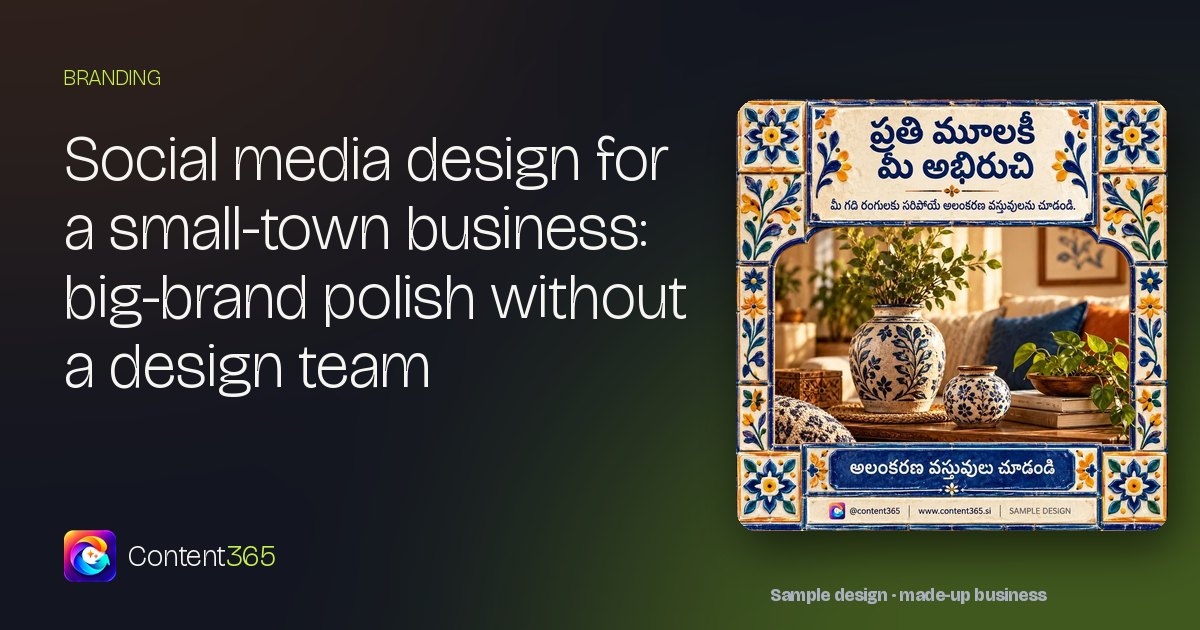
You sell the same modular kitchens as the studio in the city mall. Your carpenters are careful, your quotes are fair, and many families in town walked through your showroom before they built their homes. Then someone opens your Instagram page, and it looks like a smaller, sleepier business: a tilted photo of a sofa, a festival greeting forwarded on WhatsApp with your name typed across it in yellow, and nothing new for four months.
That gap between the shop and the page is the real problem with social media design for small town business owners. Talent and effort have little to do with it. A city chain has one person to plan, another to design and a third to write. In a district town, all three jobs usually belong to the owner, after the shutter comes down. This guide breaks big-brand design into habits you can copy, looks at how your town actually sees your posts, and gives you a one-week plan to revive a tired page.
What big-brand design really is, and what it is not
Study a chain store's page for a few minutes and the secret turns out to be less glamorous than it looks. Most of those posts are not works of art. They are simple, and they are simple in the same way every day.
Big-brand design comes down to three habits:
- Restraint. One idea per post, one headline, one picture and plenty of empty space.
- Repetition. The logo lives in one spot, the same two or three colours keep returning, and the same fonts carry the words.
- Regularity. Something new appears often enough that the page never looks abandoned.
Expensive photo shoots, clever slogans and animation are optional extras. A furniture showroom in any district town can manage all three habits. The real difference is that a chain has a system that never forgets, while a busy owner has good intentions and a long day. For the full rulebook on staying recognisable, our guide to brand consistency on social media goes deeper into logos, colours and voice.
Seven design habits a small-town business can copy this week
You can start thinking like a design team without buying any software. These habits work with whatever tool you already use.
- Say one thing. A post that announces a new sofa range, a Diwali offer and a change of address all at once says nothing clearly. Pick one message for each day.
- Make the headline readable at arm's length. Hold the phone away from you. If the headline does not register in a second, it is too small or too long. Five or six words is plenty.
- Give the logo a home. Choose one corner and use it every time, with the original file rather than a blurry screenshot.
- Pick two colours and stay loyal to them. Take them from your signboard or the paint on your shop front. Festival colours may join them for a week, but they should never push them out.
- Let the picture breathe. Clutter reads as cheap. One well-lit kitchen says more than a collage of nine.
- Keep the centre safe. Some feeds crop portrait posts towards the middle, so the headline and logo belong in the central area. Our note on the best image size for Instagram posts explains the 4:5 shape and why a square-safe centre matters.
- Put the phone number in the same place. In a small town, people call rather than send messages. Make the number easy to find, and check it digit by digit.
Designing for how your town actually sees your posts
Marketing advice written in big cities often assumes your customers scroll slowly on a large new phone. In many towns the picture is different, and good design follows the real situation.
Bright sunlight, small screens. Your posts are often seen outdoors, on a modest phone, at a bus stand or across a shop counter. Strong contrast between words and background matters far more than delicate details.
WhatsApp before Instagram. A good post can travel further as a forward in a family group than as a like on a feed. Design it so it still makes sense when shared without the caption: your name, your number and one clear message, all on the image. Our guide to WhatsApp Status marketing shows how to put the same picture to work there.
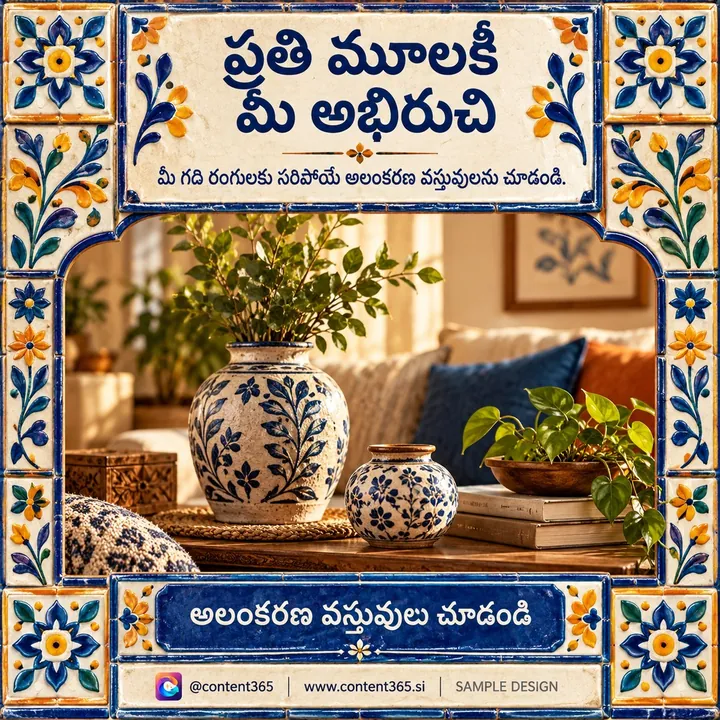
Hindi in the caption, not crammed into the picture. Many of your customers may well think in Hindi. A short Hindi caption next to the English one reaches them without crowding the design.
Your town, not a metro mood board. A furniture shop does not need to pretend it sits on a fancy city road. Warm, homely scenes that look like the homes your customers actually live in feel more honest than glossy penthouses.
Local festivals on the right day. A chain's calendar never forgets Diwali, which falls in October or November, or the harvest festivals your region celebrates. A small-town page that skips them looks shut during the busiest weeks of the year.
A one-week makeover plan for a quiet page
If your page has gone quiet, resist the urge to fix everything in one late night. Spread the work over a week, about twenty minutes a day.
| Day | Task | Why it helps |
|---|---|---|
| Monday | Find your clean logo file and write down your two brand colours | Every later post depends on these |
| Tuesday | Rewrite the bio: what you sell, which town, your phone number | Visitors decide within seconds |
| Wednesday | Archive the blurriest and oldest posts | One poor picture drags down the whole grid |
| Thursday | Photograph three of your best pieces of work in daylight | You will reuse them for months |
| Friday | Post one simple branded picture with one message | The page is visibly alive again |
| Saturday | Share the same picture on WhatsApp Status | It reaches people who already know you |
| Sunday | List next month's festivals and offers | The calendar stops catching you by surprise |
One week repairs the page. Keeping it repaired every single day for a year is the harder part, and that is where most owners run out of evenings. If you run an interiors or furniture business, our interior designer social media content guide has a full year of post ideas for your trade.
How Content365 brings big-brand design to every pin code
Content365 runs that system for you. You describe your business once, and the studio prepares your whole year: 365 branded posts, one for each day. A full year for one brand comes to ₹3,999 including GST, or about ₹11 a day. You pay once for the year, with no monthly bill, and you can see pricing for everything the plan covers.
Here is how each design habit above is kept for you, day after day:
- Your logo stays exactly yours. An image model paints only a scene, with no lettering anywhere in it. After that, the studio's compositor lays your actual logo, business name, phone, website and call to action over the scene, using the precise text you supplied. The model never draws the logo itself.
- Variety without chaos. 365 angles seen through 5 lenses give 1,825 post concepts in 21 families, drawn in 173 image styles and topped with 33 headline styles. Any picture that comes out as a near copy of another day is thrown away, so the year never feels like one template on repeat.
- The right shape. Every post is a 1080 x 1350 image with a square-safe centre, sized for Instagram, Facebook, LinkedIn, X and WhatsApp.
- Words for each platform. Each day has captions for Instagram, Facebook, LinkedIn and X, plus one in Hindi.
- A calendar that remembers. Indian festivals and the financial year sit in the plan on the days they fall.
- Checked before you see it. A vision model inspects each picture for stray text and other faults, with up to 3 tries per day.
"We want every independent business in this country to get the quality that big brands get, for ₹3,999 including GST for the whole year," says Divyaprakash Jha, Founder & CEO of Content365. He started the company with Vaibhav Jain, Vikas Jha and Zeeshan Khan, his core team. "We have worked together for ten years, from Python to machine learning to AI," he says. "Giving a shop in a small town the same quality as a big brand is exactly what that work should be for."
You keep the final say. Every day waits in your own gallery first, and you or your team post it; Content365 does not post on your pages. To see finished posts across trades, browse the sample library or the showcase.

Frequently asked questions
Does a small-town business really need polished posts?
Your page is often a new customer's first look at you, even in a town where people know each other. A clean, regular page simply confirms that the shop is open and cared for, the same message your counter gives in person.
Should I copy the style of a big city brand?
Copy the habits rather than the look. Keep one message per post, a fixed logo spot and two steady colours, but show scenes and words that suit your own town and your own customers.
How many colours and fonts should I use?
Two or three colours taken from your signboard or shop, one font for headlines and one for details. Anything beyond that starts to look messy on a small screen.
Will Content365 posts look like everyone else's template?
No. The year draws on 1,825 concepts in 21 families across 173 image styles and 33 headline styles, near copies are discarded, and your own logo, name and details sit on every post.
Can I try it before I pay?
Yes. On the free plan you get 2 posts for your own brand every 48 hours, and you pay nothing. Sign in with Google to begin.
Look as good online as you do in person
Your shop already does the hard part: good work, fair prices and customers who trust you. The page only has to say so, every day. Start free with your own brand, and when you want the whole year designed for you, look at the yearly plan at ₹3,999 including GST or check what the price covers.