Social media for manufacturers and MSMEs: how factories can post every day on LinkedIn and Instagram
Social media for manufacturing companies, made practical: LinkedIn and Instagram post ideas for factories and MSMEs, a weekly rhythm and a yearly plan.
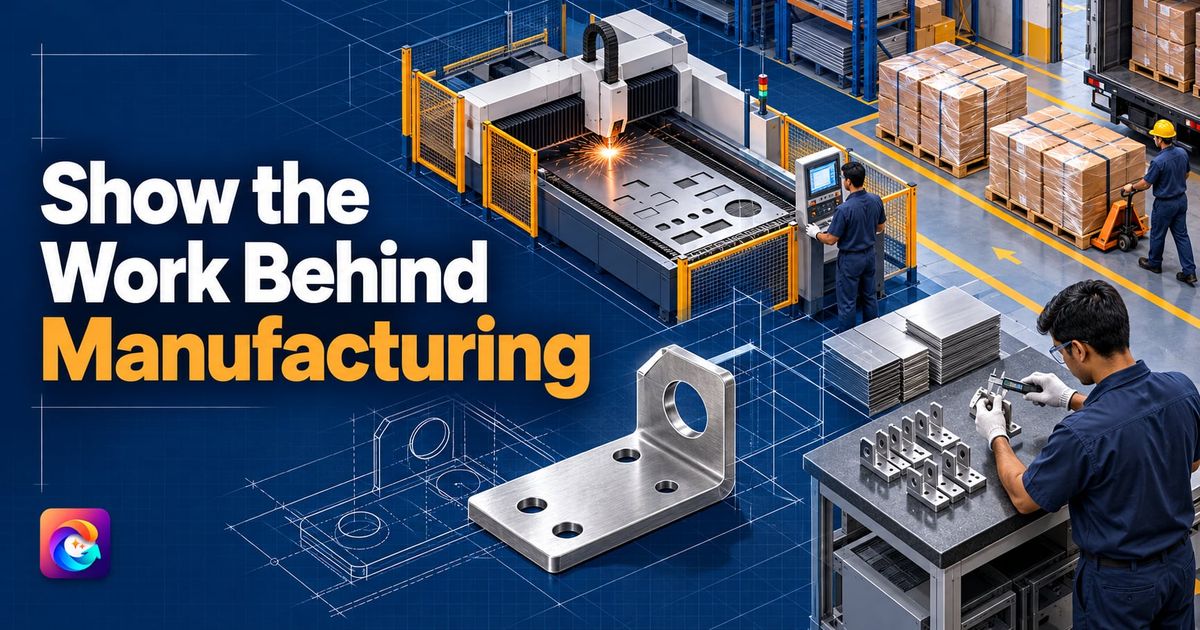
A purchase manager in Pune is shortlisting three vendors for sheet metal enclosures. He has your quotation, your catalogue PDF and your visiting card. Before he calls, he types your company name into LinkedIn and Google. One competitor's page shows a new laser cutting machine, a factory visit by a client and a post about their quality checks last week. Your page shows a Diwali greeting from two years ago and a logo.
Nobody tells you that you lost the order because of that. But it happens, quietly, every month. That is why social media for manufacturing companies is no longer only for big brands. For an MSME, a fabrication unit or a component maker, your page is the factory visit a buyer makes before deciding whether to visit at all. The problem is not that you have nothing to show. It is that the owner is on the shop floor, the accounts person is chasing payments, and nobody has the hour a day it takes to make a proper post. This guide shows you what to post, where, and how often, without hiring a marketing team.
Why social media for manufacturing companies matters
Industrial buying is slow and careful. A buyer may watch a supplier for months before sending a trial order. During that time, your page answers questions he will never ask on the phone:
- Is this company still active and growing, or struggling?
- What machines do they actually have, and what tolerances can they hold?
- Do they take quality seriously: inspection, testing, documentation?
- Do they deliver on time, and can they handle a larger order?
- Are they the kind of people I can trust with my drawings?
A page that posts regularly, even simple posts, says "we are working, we are serious, we are here". A dead page says nothing, and in B2B, nothing usually reads as risk.
There is a second audience too: people who might work for you. Skilled welders, machinists, supervisors and engineers look at a company's page before they apply. Regular posts about safety, training and your team make hiring easier.
LinkedIn or Instagram: where should a manufacturer post?
Both, but for different reasons.
LinkedIn is where buyers, procurement teams, consultants and engineers spend their working hours. For manufacturers, B2B LinkedIn posts in India do well when they are specific: a new machine and what it lets you make, a capability explained simply, a certification renewed, an export shipment packed. Post from the company page, and let the owner reshare from a personal profile, which usually travels further. Our guide on LinkedIn posts for business owners goes deeper into that rhythm.
Instagram and Facebook suit the visual side: sparks, bending, finished products, packed pallets, the shop floor at the start of a shift. Dealers, contractors, small buyers and future employees often find you here. WhatsApp Status works for your existing dealers and customers, who already have your number.
The caption style is different on each platform, even for the same picture. A LinkedIn caption explains the business value; an Instagram caption is shorter and more visual. If you want a guide to adapting one post for each, read one post, four platforms.
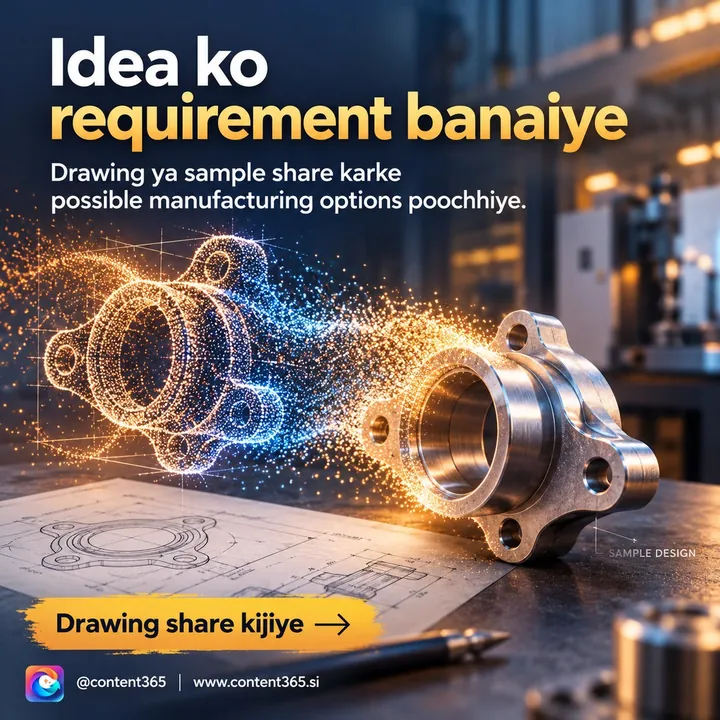
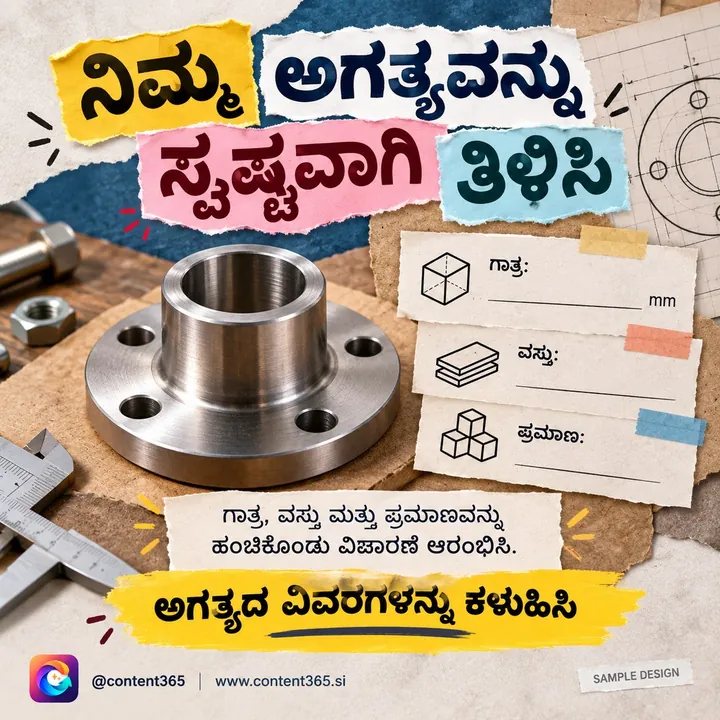
The picture above was made for a made-up custom manufacturing workshop. The headline, "Turn your idea into a requirement" (in Hinglish on the sample), is about capability, not just a greeting.
Industrial company content: what to post when you think you have nothing
Most factory owners say, "What will we post? We just make parts." In fact, a manufacturing unit has more to show than most businesses. Here are eight kinds of industrial company content that work:
- Capabilities. One process per post: laser cutting, CNC turning, powder coating, MIG welding, injection moulding. What it is, what size and material range you handle, and what it is used for.
- Machines. A new machine arriving, being installed, or running. Buyers care about capacity.
- Quality. Inspection tools, gauges, test reports, how you check the first piece and the last piece of a batch. Say what you actually do; never claim certifications you do not hold.
- Materials. The difference between grades of steel, why a certain finish lasts longer outdoors, how to choose a sheet thickness. Educational posts are saved and shared by engineers.
- Applications. Where your products end up: a panel in a hospital, a rack in a warehouse, a part inside a tractor. Ask the client before naming them.
- People and safety. Safety gear, toolbox talks, training days, long-serving workers. These posts build trust with buyers and job-seekers alike.
- Dispatch. Packed, labelled, loaded trucks. A quiet sign of a busy, reliable company.
- Occasions. Republic Day, Independence Day, Vishwakarma Puja in September, Diwali in October or November, the start of the financial year in April, and MSME Day on 27 June.

Notice that none of this needs a professional photographer. But it does need someone to turn it into a clean, branded post every day, and that is where most units fall behind.
Fabrication business marketing: talk like an engineer, not like an advertisement
Fabrication business marketing goes wrong when it copies consumer advertising. Words like "world class", "best quality" and "number one" mean nothing to a buyer who has heard them from every vendor. What works is plain, specific language:
- Instead of "best quality fabrication", say "MS and SS fabrication, sheet thickness range and bending length as per your drawing".
- Instead of "fast delivery", explain your process: drawing review, sample approval, batch production, inspection, dispatch.
- Instead of "trusted by many clients", show the type of work you do, with permission, and let the buyer decide.
Keep the tone confident and modest. Never post a drawing, a client's design or a part that a client considers confidential without written permission. In manufacturing, discretion is part of your brand.
A weekly rhythm and a yearly plan for an MSME
Here is a simple weekly rhythm that a small unit can follow, with LinkedIn and Instagram in mind:
| Day | LinkedIn focus | Instagram and WhatsApp focus |
|---|---|---|
| Monday | A capability explained | Machine or process in action |
| Tuesday | A materials or design tip | Close-up of a finished part |
| Wednesday | Quality and inspection | Shop floor picture |
| Thursday | Application of your product | Product in use |
| Friday | Team, safety or training | Worker or team spotlight |
| Saturday | Company news, new machine, exhibition | Dispatch and packing |
| Sunday | Thought for the week or a greeting | Light post or festival greeting |
Over the year, layer in these moments:
- January: new year plans, Republic Day.
- February: the Union Budget, with a general note on what you are watching as a manufacturer; leave tax interpretation to your CA.
- March: financial year-end push, Holi greeting.
- April: new financial year, fresh capacity or price lists if you have them.
- June: MSME Day.
- August: Independence Day, a "made in India" angle on your work.
- September: Vishwakarma Puja, a natural day to honour your workers and machines.
- October and November: Navratri, Dussehra and Diwali greetings, with dispatch schedules for the festive weeks.
- December: year-in-review, exhibitions and trade fairs you will attend.
These MSME marketing ideas cost almost nothing to execute. What they cost is time, and that is the real shortage in a factory. If you also deal in building materials, our post on building materials dealer marketing has more ideas for the trade side.
How Content365 gives your factory a post for every day
Content365 makes a year of branded posts for your company, so the page keeps moving while you run production. You give it your company name, logo and website, and it prepares 365 branded posts, one for every day of the year.
- One image per day, 1080 x 1350 in the 4:5 shape with a square-safe centre, ready for LinkedIn, Instagram, Facebook, X and WhatsApp.
- Your real company details on every post. The image model paints an industrial scene with no text in it; the studio's compositor then places your logo, company name, phone, website and call to action on top, from the exact text you gave. Your logo is never redrawn by the model.
- Captions for Instagram, Facebook, LinkedIn and X, plus Hindi, every day. The LinkedIn caption is written for a professional reader, and the Hindi one helps with dealers and staff.
- Indian festivals and the financial year planned in on the days they fall, including year-end and the new financial year.
- A year that does not repeat itself. 365 angles across 5 lenses make 1,825 concepts, grouped into 21 angle families and mixed through the year. Near-duplicate pictures are rejected.
- Checked pictures. A vision model checks every picture for stray text and problems, with up to 3 tries per day. A day that never passes still arrives, with a visible warning.
- No invented claims. Ratings, testimonials, awards, certifications and statistics appear only when you confirmed them. That matters in B2B, where a wrong claim can cost an order.
You review every day in your own gallery first. Nothing posts by itself, and we do not post on your pages. You or your team post them. Everything comes in one download folder with all the pictures, captions.csv, prompts.csv, calendar.csv and a gallery that opens on any phone.
The cost is ₹3,999 including GST for the whole year for one brand, not per month. If your group has two companies with different names, each extra brand is the same ₹3,999 including GST. Posts stay hosted for 90 days from payment, then ₹3,000 a year (before GST) to keep them hosted, or keep the downloaded folder.
Want to see what your company's posts would look like? The free plan gives you 2 posts for your brand every 48 hours, with no payment. Sign in with Google and start free, or browse the sample library by industry.
Frequently asked questions
Does a B2B manufacturing company really need social media?
Yes, in a quiet way. Buyers, engineers and job-seekers check your page before they call or apply. Steady, specific posts tell them you are active and serious. You do not need viral posts; you need a page that looks alive and professional.
Should a factory post on LinkedIn or Instagram?
Both. LinkedIn reaches buyers, procurement teams and engineers. Instagram and Facebook suit visual posts of machines, processes and finished products, and WhatsApp Status keeps dealers and existing customers in touch.
Can I post pictures of client parts and drawings?
Only with the client's written permission. Many clients treat drawings and designs as confidential. When in doubt, show your process, machines and generic finished work instead of a specific client's part.
Will Content365 post on our LinkedIn page?
No. Content365 makes the posts and captions for every day. You review them and post them yourself; we do not log in to your accounts or schedule anything.
Can the posts mention our certifications?
Only if you confirmed them. Certifications, awards and similar claims appear only when your brand has confirmed them, so nothing is claimed on your behalf.
Give your factory a page that works as hard as the shop floor
Your machines run every day. With social media for manufacturing companies made this simple, your page can too. See pricing for the yearly plan, try the free posts if you want to test it first, and let the next purchase manager who looks you up find a company that is clearly busy and clearly serious. One price covers the whole year.