Content365BlogCaptions and language
Hinglish, Hindi or English? Choosing the right language for your business posts
Hinglish captions for business, Hindi in Devanagari or plain English? A practical way to choose by customer, product and platform, with one post written three ways.
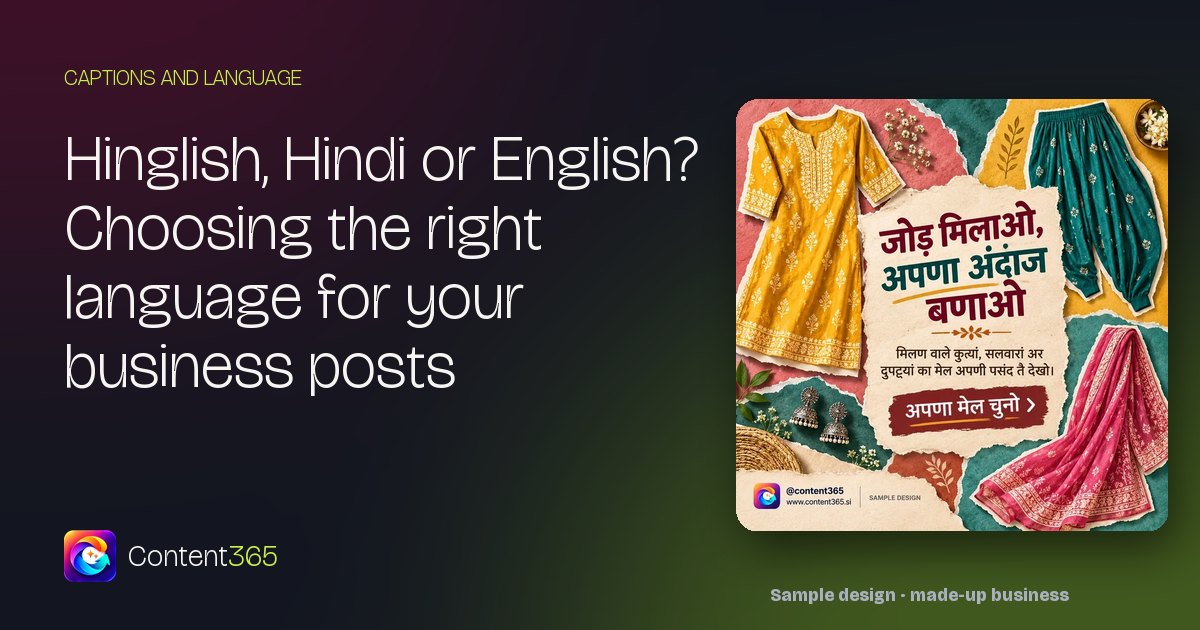
Your ethnic wear shop has two kinds of customers. One is the college girl who messages "Di, yeh wala lehenga M size mein hai?" at eleven at night. The other is her mother, who walks in on Saturday, reads the price tags carefully and prefers to talk in Hindi. Then there is the cousin in Pune who buys online and only reads English. You have one Instagram page for all of them, and every time you write a caption, you are not sure which language to write it in.
That doubt is common, and it is worth settling once rather than every day. Hinglish captions for business, Hindi in Devanagari and plain English each have a place. The trick is knowing which one fits which customer, which post and which platform. This guide gives you a simple way to decide, one post written three ways, and the practical details: consistent Hinglish spelling, Devanagari captions that display properly, and other regional languages.
Start with who reads, not what sounds smart
Many owners pick the language that feels most "professional", usually English. But a caption is a message to a customer, and it should sound the way you already talk to them.
Ask three questions before you choose:
- How do your customers message you? Scroll through your WhatsApp chats. If most of them write "Kal shop khuli hai?" then Hinglish is their natural voice. If they write in Devanagari, Hindi is. If they write "Is the shop open tomorrow?", English is.
- Where do they live? A shop serving one neighbourhood in a Hindi-speaking city can lean towards Hindi and Hinglish. A brand that ships across India needs English as the base.
- How old are they? Younger buyers often read Hinglish fastest. Many older customers are more comfortable with Hindi in Devanagari, and some read English with ease. Do not assume: look at who actually buys.
The answer is rarely one language. For most Indian businesses, the honest answer is a mix, used on purpose.
Hindi vs English posts: what each does well
Here is how the three options compare in practice.
| English | Hindi (Devanagari) | Hinglish (Roman script) | |
|---|---|---|---|
| Best for | Pan-India reach, LinkedIn, product details | Greetings, blessings, older customers, trust | Casual offers, younger buyers, Instagram and WhatsApp |
| Feels like | Clear and neutral | Warm and familiar | Chatty, like a message from a friend |
| Watch out for | Sounding stiff or like a pamphlet | Heavy, formal words nobody uses | Messy spelling, too much slang |
| Good example line | "Our new festive collection is here." | "नया त्योहारी कलेक्शन आ गया है।" | "Naya festive collection aa gaya hai." |
The Hindi vs English posts question really comes down to the job each post has to do.
One post, written three ways
Let us take one real post for an ethnic wear shop: wedding season stock has arrived, and you want people to come in and see it.
English
"Wedding season is here. Our new lehengas and sharara sets are in the store in rich colours, and we will alter them to fit you. Come and see them this weekend."
Hindi
"शादियों का मौसम आ गया है। नए लहंगे और शरारा सेट खिले-खिले रंगों में दुकान पर आ चुके हैं, और फ़िटिंग हम आपके नाप से कर देंगे। इस शनिवार-रविवार आकर ज़रूर देखिए।"
Hinglish
"Shaadi season aa gaya hai. Naye lehenge aur sharara sets store mein aa chuke hain, ekdum rich colours mein. Is weekend aake dekhiye, fitting hum kar denge."
The English version is clearest for someone who has never visited. The Hindi version feels respectful and homely, the way you would speak to an aunty at the counter. The Hinglish version sounds like a WhatsApp message, and "fitting hum kar denge" feels personal.
None of them is a word-for-word translation of the others. Each says the same thing the way a real person would say it in that language. That is the single most important rule of bilingual writing.
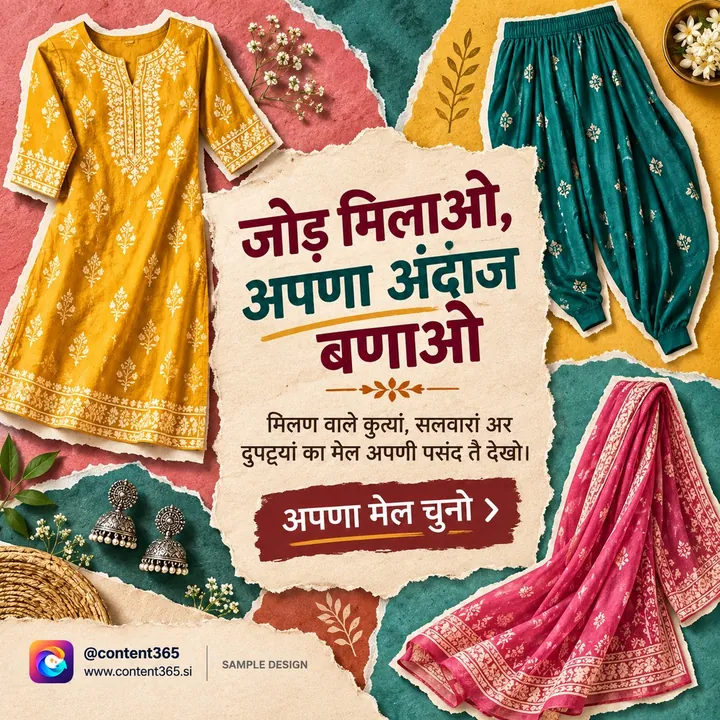
Bilingual marketing in India: four ways to mix languages
Bilingual marketing in India does not mean writing everything twice. Here are four patterns that work, from simplest to most effort.
- English caption, one Hindi line. Write the caption in English and add a warm Hindi line at the end, such as "आपका इंतज़ार रहेगा।" (We will be waiting for you). Easy, and it adds a human touch.
- Hindi caption, English details. Write the feeling in Hindi and keep sizes, timings and the address in English or numbers, which everyone reads the same way.
- Alternate by day. Use Hinglish for daily offers, Hindi for greetings and Sunday posts, English for product details and LinkedIn. Your page stays varied and every group feels seen.
- Full bilingual. Hindi paragraph first, English paragraph below, separated by a blank line. Best for festivals and important announcements where nobody should miss the message.
Pattern 1 takes one extra minute a day. Pattern 4 is worth it for a handful of big days in the year. If you would rather not write any of them yourself, see what a year of ready captions costs.
Getting Hinglish captions for business right
Hinglish is how most people type on their phones, but it is easy to get sloppy.
Choose one spelling and stick to it
Hinglish has no fixed spelling. "Hai" or "hain", "aaj" or "aj", "dekhiye" or "dekhie". Readers forgive variety, but a page that spells the same word three ways in one week looks careless. Make a small list of your most-used words and keep it on your phone:
- aaj (today), kal (tomorrow / yesterday), abhi (now)
- naya, naye, nayi (new, matched to the word after it)
- dekhiye, aaiye, bataiye (polite "see", "come", "tell us")
- dukaan or store (pick one and keep it)
Keep it polite
"Aao" sounds rough to many customers. "Aaiye" or "aaiyega" is warmer and still casual. In a shop, "aap" is almost always safer than "tum".
Do not overdo the slang
"Ekdum mast collection" works once in a while. A caption full of slang makes the brand look young and unserious, which may not suit a bridal wear store.
Devanagari captions: making Hindi look right
Hindi in Devanagari carries a special warmth for greetings and blessings, but a few practical details trip people up.
- Typing it. Most phone keyboards, including Gboard and the iPhone keyboard, let you add Hindi. Many owners type in Roman letters and let the keyboard convert, for example typing "shubhkamnayein" to get "शुभकामनाएँ". Always check what it picks, because it often guesses the wrong word.
- Simple words win. "हार्दिक शुभकामनाएँ" is fine for a festival. But for everyday posts, choose the words you would actually say. "आइए, देखिए" beats "पधारें और अवलोकन करें" every time.
- Nuqta and chandrabindu. Small marks matter. "ज़रूर" and "आएँ" look more careful than "जरूर" and "आएं" to some readers, though both are widely accepted. Pick one style and stay consistent.
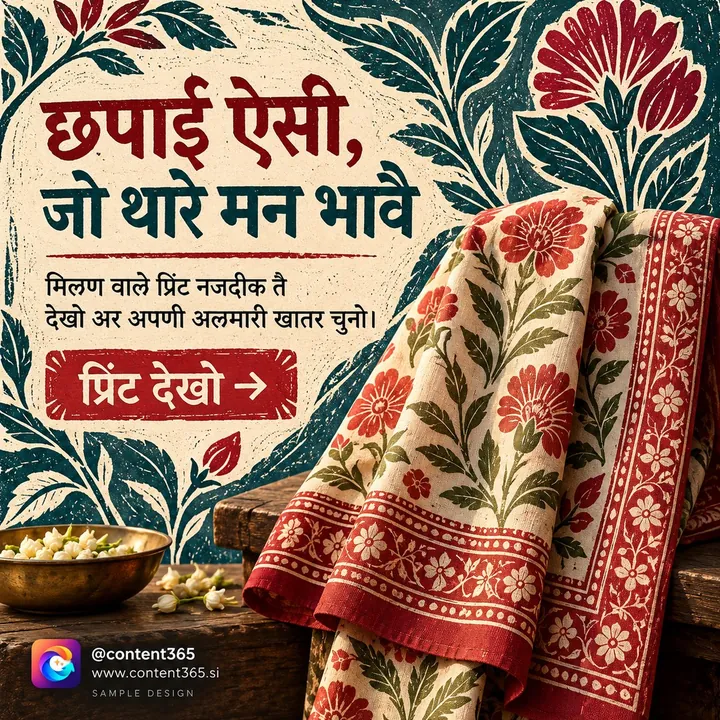
- Text inside pictures. If you put Hindi on the image, check it on your phone. Many design tools break joined letters or put the matras in the wrong place, and a broken word on a festival greeting looks very bad.
Our earlier guide on Hindi captions for business posts has more ready-to-use Hindi lines for daily posts if you want a starting set.
Regional language content beyond Hindi
India is not only Hindi and English. A boutique in Surat may find its regulars prefer Gujarati, and a shop in Kolkata, Chennai or Kochi will often do better with Bengali, Tamil or Malayalam than with Hindi.
Regional language content follows the same rule: speak the way your customers speak.
- Keep your main caption in English (or Hindi), and add one greeting line in the local language on festivals and Sundays.
- Ask a staff member or family member who speaks the language natively to check the line. Translation apps are not reliable enough for public posts.
- Use the local language most for local festivals, where it means the most.
How Content365 handles the language question
Writing a fresh caption every day, in two languages, for a year, is where most owners give up. Content365 takes that daily writing off your plate.
For every day of the year, you get captions written for Instagram, Facebook, LinkedIn and X, plus one in your own language. If Hindi is your brand's language, or your posts are in English, that fifth caption is in Hindi, in Devanagari. That means you have an English version and a Hindi version for the same post, and you can use either, combine them, or turn a line into Hinglish in your own words before you post. Many owners find that the quickest way to get good Hinglish captions for business is to start from a finished Hindi line and simply retype it in Roman letters with a few English words. Everything is in your gallery and in one captions.csv file in your download folder.
On the picture itself, an image model paints a scene with no text in it, and the studio's compositor places your real logo, business name, phone, website and call to action on top from the exact text you gave, so there are no broken letters drawn by the model. Each post is a 1080 x 1350 image with a square-safe centre, ready for Instagram, Facebook, LinkedIn, X and WhatsApp. Indian festivals are planned into the calendar on the days they fall, so a greeting is ready for each one.
You review every day in your gallery first. We do not post on your pages: you or your team post them, in the language mix that suits your customers. The whole year is ₹3,999 including GST for one brand and 365 posts, not per month, and you can check what the yearly plan includes. If you run a second brand, it is the same ₹3,999 including GST again.
See your posts in both languages, free
The easiest way to decide is to see a real post for your own shop with both captions. The free plan gives you 2 posts for your brand every 48 hours, with no payment needed. Start free with Google sign-in. For more ideas built around clothing stores, read the fashion boutique Instagram content guide, and to tune each caption for a platform, see captions for Instagram, Facebook, LinkedIn and X.
Frequently asked questions
Is Hinglish professional enough for a business page?
For everyday offers and friendly posts on Instagram and WhatsApp, yes. It matches how many customers type. For notices, price changes and anything official, use clear English or Hindi instead.
Should I write Hindi in Devanagari or in Roman letters?
Both work for different readers. Devanagari feels warmer and more respectful, especially for greetings and older customers. Roman-script Hindi, which is Hinglish, is quicker to read for many younger buyers. Many shops use Devanagari for festivals and Hinglish for daily offers.
Will posting in Hindi put off my English-speaking customers?
Not if you mix sensibly. Keep key details such as sizes, timings and prices easy for everyone to read, and add an English line when the message matters to all your customers.
Can I use Google Translate for my Hindi captions?
Use it only as a first draft. Machine translation often sounds stiff or picks the wrong word. Read the line aloud, and ask someone who speaks Hindi daily to check anything important.
Does Content365 write Hinglish captions?
Content365 writes captions in English for Instagram, Facebook, LinkedIn and X, plus a fifth caption in your own language: Hindi if you choose Hindi, or if your posts are in English. You can easily turn either into Hinglish in your own voice before you post.
Talk to customers in their language
Your customers have already told you which language they prefer, in the way they message and the way they talk at the counter. Follow their lead: Hindi for warmth, Hinglish for everyday chat, English for clarity. If you want both an English and a Hindi caption ready for every day of the coming year, see pricing for a full year of posts and start from there.